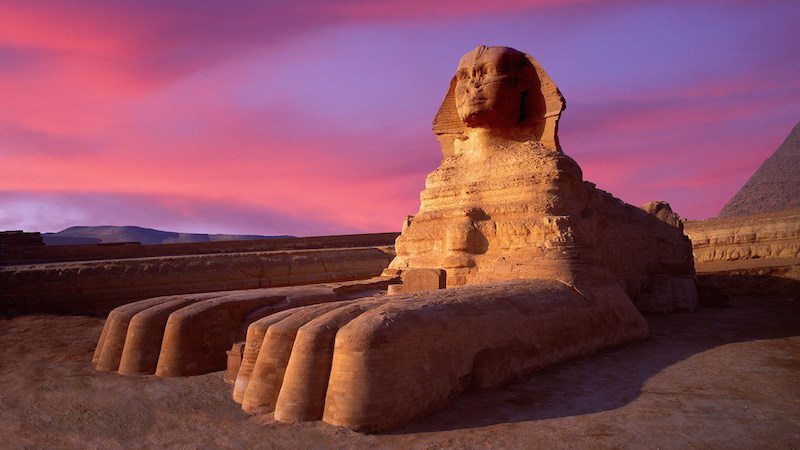
The Great Sphinx of Giza is perhaps the most enigmatic statue in human history—a colossal fusion of a lion’s strength and a Pharaoh’s wisdom. Carved directly from the living limestone of the Giza Plateau, it serves as the eternal silent sentinel of the necropolis, facing the rising sun to symbolize the resurrection of the King.
At Top Class Egypt Travel, we present the Sphinx as more than a monument; it is a 4,500-year-old riddle that continues to captivate the world’s greatest archaeologists and historians.
A Monolith of Mystery: Dimensions and Origin
The Great Sphinx holds the distinction of being the oldest known monumental sculpture in Egypt and one of the largest monoliths on the planet.
-
The Colossal Scale: Measuring 73 meters long and 20 meters high, the statue was carved from a single outcropping of limestone bedrock left over from the construction of the Great Pyramid.
-
The Royal Face: Most Egyptologists believe the Sphinx bears the likeness of Pharaoh Khafre (4th Dynasty), designed to portray the King as a divine guardian. The nemes royal headdress and the uraeus (cobra) on the forehead are hallmarks of supreme Pharaonic authority.
-
The Dream Stela: Situated between the Sphinx’s giant paws is a massive granite slab placed there by Thutmose IV (18th Dynasty). It tells the legendary story of how the Sphinx appeared to the young prince in a dream, promising him the throne if he cleared the encroaching desert sands from its body.
Beyond the Statue: The Sphinx Enclosure
A visit with Top Class Egypt Travel provides an expert-led look at the complex surrounding the Great Sphinx:
-
The Sphinx Temple: Directly in front of the statue lie the ruins of its dedicated temple. Unusually, it features two sanctuaries—one for the rising sun and one for the setting sun—highlighting the Sphinx’s solar significance as Horemakhet (Horus in the Horizon).
-
The Causeway: The Sphinx sits adjacent to the causeway leading from the Valley Temple of Khafre to his pyramid, physically linking the Pharaoh’s mummification site with his eternal resting place.
-
The "Lost" Features: While the nose and beard are famously missing, traces of red, blue, and yellow pigment can still be found behind the ears, suggesting that the Sphinx was once a vibrantly painted masterpiece visible from miles away.
Expert Recommendations for a Top-Tier Visit
-
The Elite Vantage Point: While most tourists view the Sphinx from a distance, we provide access to the Private Viewing Platform beside the Sphinx’s paws. This allows for a prestigious, up-close perspective where you can see the intricate layers of the limestone and the Dream Stela with total clarity.
-
The Golden Hour: The Sphinx is best photographed in the early morning or late afternoon. As the sun moves across the sky, the shadows accentuate the features of the face, revealing the subtle artistry that is lost in the flat midday light.
-
Sound and Light Context: For a truly evocative evening, we recommend the Giza Sound and Light Show, where the Sphinx acts as the narrator, recounting the history of the plateau under a canopy of stars.
-
Traveler’s Perspective: To stand before the Great Sphinx is to confront the deep time of human civilization. It is a monument that does not just represent history; it watches history pass by. It remains the ultimate symbol of Egypt’s enduring and mysterious soul.