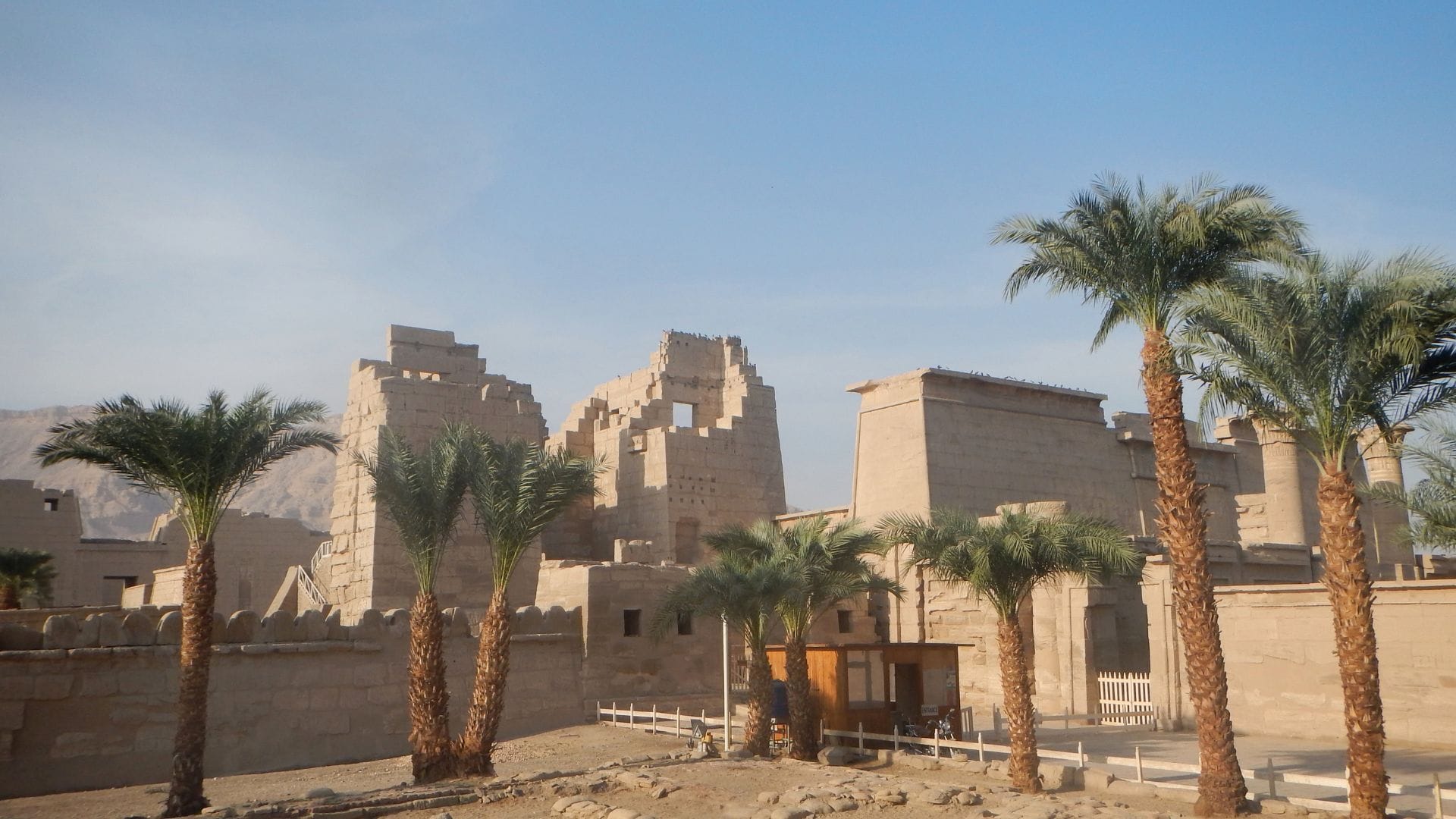
The Mortuary Temple of Ramses III, known as Medinet Habu, is one of the most underrated yet awe-inspiring sites on the West Bank of Luxor. While the Valley of the Kings holds the tombs, Medinet Habu holds the history—preserved in stone with a depth and color that is virtually unmatched in Egypt.
At Top Class Egypt Travel, we recommend this site for travelers who appreciate military history and architectural grandeur. It is a massive, fortified complex that served not only as a place of worship but as a royal palace and a defensive stronghold.
Medinet Habu: The Fortified Glory of the Last Great Pharaoh
As the final great warrior pharaoh of the New Kingdom, Ramses III designed his mortuary temple to be an impenetrable "Mansion of Millions of Years." The sheer scale of the mud-brick enclosure walls and the towering stone pylons reflect a period of both immense wealth and necessary defense against foreign invaders.
The Migdol: A Syrian-Style Gateway
Uniquely in Egypt, the entrance to Medinet Habu is modeled after a Migdol, a type of fortified gatehouse found in ancient Syria. This distinctive entrance immediately signals the military focus of Ramses III's reign and provides an imposing prelude to the sacred space within.
Deep-Cut Reliefs and Vivid History
The artistry at Medinet Habu is famous for its technical style. The hieroglyphs and figures are carved exceptionally deep into the sandstone—a deliberate strategy by the Pharaoh to ensure that his name and deeds could never be erased or usurped by future rulers.
-
The Sea Peoples Battle: The exterior walls feature the most detailed records in existence of Egypt’s victory over the "Sea Peoples," a confederation of naval invaders. These reliefs are a primary source for historians studying the collapse of the Bronze Age.
-
The Royal Hunt: Observe the energetic scenes of the Pharaoh hunting wild bulls and desert game, symbolizing his ability to maintain order over the chaotic forces of nature.
-
The Colors of Antiquity: In the inner courtyards, particularly beneath the ceilings and around the column capitals, you will see some of the most vibrant original blue, red, and yellow pigments remaining in any Egyptian temple.
The Royal Palace and the Holy of Holies
Adjacent to the first courtyard lies the remains of the Royal Palace. While the Pharaoh lived across the river in Thebes, this palace was used during major religious festivals. You can still see the "Window of Appearances," where Ramses III would address his subjects and reward his victorious generals.
Expert Recommendations for a Top-Tier Visit
-
The Crowd-Free Experience: Because it is slightly south of the main West Bank cluster, Medinet Habu is significantly quieter than Karnak or the Valley of the Kings. At Top Class Egypt Travel, we utilize this silence to provide a private, immersive lecture on New Kingdom politics and warfare.
-
Photographic Depth: The deep-cut carvings create dramatic shadows during the mid-morning and late afternoon. It is the best site in Luxor for capturing the "texture" of ancient Egyptian wall art.
-
Strategic Pairing: We suggest pairing Medinet Habu with a visit to the Valley of the Queens. Since Ramses III's children and his favorite wife, Queen Isis, are buried nearby, it completes the narrative of his family’s legacy.
-
Traveler’s Perspective: Medinet Habu feels like a fortress frozen in time. It is where the power of the Pharaonic state is most visible, documented in stone that refuses to weather. It is a powerful, masculine monument to a king who fought to keep his empire alive.