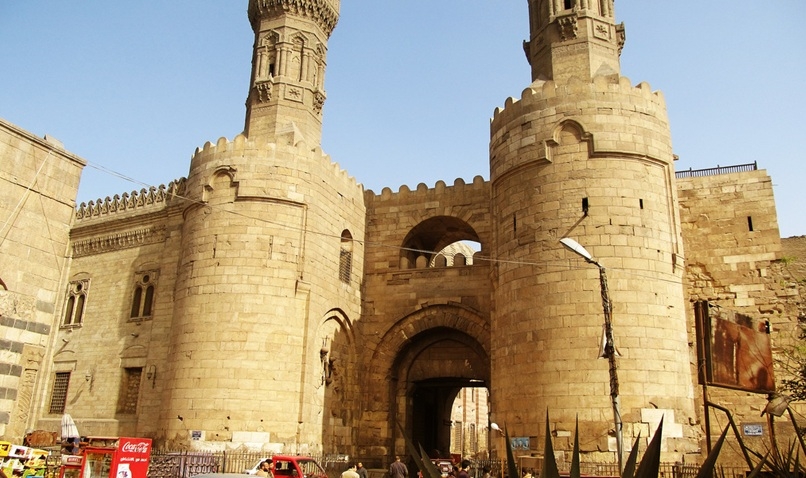
Bab Zuweila: The Towering Gate of a Thousand Histories
Standing as the monumental southern gateway to the 11th-century walled city of Al-Qahira, Bab Zuweila is one of the most iconic survivors of Egypt’s medieval golden age. Built in 1092 by the Fatimid vizier Badr al-Jamali, the gate has transitioned through history from a formidable military bastion to a center of folk legend and, finally, to the most spectacular vantage point in Islamic Cairo.
Named after the Zuwayla, a Berber tribe of Fatimid soldiers once garrisoned nearby, the gate is a masterpiece of stone masonry that has witnessed the rise and fall of dynasties for nearly a millennium.
Architectural Grandeur: The Fusion of Power and Faith
Bab Zuweila is a triumph of Fatimid military architecture, characterized by its two massive semi-circular towers and a heavy iron-bound gate. However, its most striking visual feature was added centuries later.
-
The Twin Minarets: In the early 15th century, Sultan al-Mu’ayyad Shaykh constructed his magnificent mosque adjacent to the gate. In a stroke of architectural genius, he utilized the existing towers of Bab Zuweila as the foundations for the mosque’s two soaring minarets. This unique integration makes the gate appear as if it is crowned by the heavens.
-
The Sultan’s Vow: Legend says the Sultan built the Mosque of Sultan al-Mu’ayyad [or similar] on this site because he had been imprisoned in the jail that previously stood here. Suffering from the conditions, he vowed that if he ever came to power, he would transform the place of misery into a place of worship and education.
A Stage for History: From Royal Pomp to the Gallows
Throughout the Mamluk and Ottoman eras, Bab Zuweila was the beating heart of Cairo’s public life. It served as the starting point for the Mahmal, the grand annual procession that carried the new Kiswah (the black silk covering for the Kaaba) from Cairo to Mecca.
However, the gate also held a darker reputation as the city’s primary site for public executions.
-
The Fall of the Mamluks: The most poignant moment in the gate's history occurred in 1517. Tumanbay II, the last Mamluk Sultan, was hanged here by the Ottoman Turks. His death marked the definitive end of the Mamluk Sultanate and the beginning of centuries of Ottoman rule in Egypt.
The Summit: Cairo’s Best Panoramic View
For the modern traveler, the true allure of Bab Zuweila lies at the top. Climbing the internal staircase to the ramparts and then ascending the minarets offers a perspective of Cairo that is unrivaled:
-
The Minaret Horizon: From the top, you can see the "City of a Thousand Minarets" stretching to the horizon. You’ll have a bird's-eye view of the Al-Muizz Street artery, the Citadel of Saladin, and the nearby Tentmakers' Bazaar (Al-Khayyamiyya).
-
Spiritual Folklore: As you pass through the gate, look for the massive wooden doors. Historically, locals believed the spirit of a saint (al-Mitwalli) resided here. For centuries, people would leave teeth, scraps of clothing, or nails in the cracks of the door as "votive offerings" to seek healing.
Expert Recommendations for a Top-Class Visit
-
The Best Light: We recommend climbing the minarets in the late afternoon. The soft light of the setting sun illuminates the limestone of the surrounding mosques, turning the city into a golden tapestry.
-
Combine with a Walk: Start your journey at Bab Zuweila and walk north through Al-Muizz Street. It is the most concentrated collection of medieval Islamic architecture in the world.
-
Photography Note: The view from the western minaret offers the best angle of the Mosque of Sultan al-Mu’ayyad’s dome and the bustling street life below.
Traveler’s Note: To stand atop Bab Zuweila is to stand at the intersection of myth and reality. It is a place where you can feel the weight of centuries beneath your feet while looking out over the vibrant, living heart of modern Cairo.